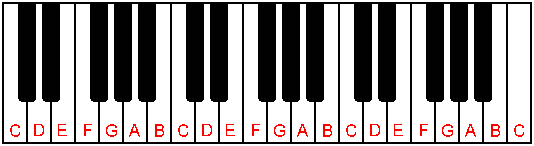

The spacing between adjacent notes on the chromatic scale is referred to as a half step. The number of half steps between adjacent notes for the common musical scales used in western music are:
The major and natural minor scales occur in pairs which share the same set of notes, but start in a different place. For example, if you stick to the white keys on the piano and start your scale on C, then it is the C major scale. If you start on A, it is the A minor scale. Since there are seven possible starting notes, you get seven possible "modes." The Greeks gave them all names.
| Modes Using Notes ABCDEFG | ||
|---|---|---|
| Starting Note | Ancient Greek Name | Comments |
| A | Aeolian (or Hyperdorian) | Natural Minor |
| B | Myxolydian | |
| C | Lydian | Major Scale |
| D | Phrygian | |
| E | Dorian | |
| F | Syntolydian | |
| G | Ionian (or Hypophrygian) | |
Changing the starting note can give a different feel to the music and can be applied to any scale. For example, if you start the Harmonic minor scale on its fifth note you get intervals of (1-3-1-2-1-2-2) which is sometimes called the "spanish gypsy scale."
Other scales include the five note pentatonic scales and the six note blues and whole-tone scales.
If you want to try these on a keyboard but don't have any experience,
refer to this figure: